

TLDR
Moissanite is a lab-created silicon carbide gemstone, not a diamond. It costs roughly 80-90% less, throws more rainbow fire, and scores 9.25 on the Mohs hardness scale (diamond is 10). Both work for daily-wear engagement rings. The right choice depends on whether you want maximum sparkle per dollar (moissanite) or diamond identity with classic white brilliance (lab-grown or natural diamond).
What Does Moissanite Versus Diamond Mean?
Moissanite versus diamond is the comparison shoppers make when choosing a center stone for an engagement ring or fine jewelry. Both stones are clear, hard, and brilliant, but they are completely different materials.
Diamond is crystallized carbon. It can be mined from the earth or grown in a laboratory. Moissanite is silicon carbide, and nearly all moissanite sold in jewelry today is lab-created. The FTC’s consumer guidance on gemstones warns buyers that moissanite may look like a mined diamond but is not the same stone.
That distinction matters. Moissanite is real moissanite, not fake diamond. It has its own optical personality, its own price structure, and its own reasons for being chosen. Calling it “fake” misrepresents what it is. Calling it “basically the same as diamond” also misrepresents what it is.
Browse oval moissanite engagement rings to see the stone’s personality for yourself.
Moissanite vs Diamond: Quick Comparison
| Feature | Moissanite | Diamond |
|---|---|---|
| Material | Silicon carbide | Carbon |
| Origin | Almost always lab-created | Natural or lab-grown |
| Mohs hardness | About 9.25 | 10 |
| Sparkle type | Strong rainbow fire | Classic white brilliance |
| Refraction | Doubly refractive | Singly refractive |
| Dispersion | 0.104 | 0.044 |
| Price range (1ct equivalent) | Roughly $500 to $600 | Roughly $3,000 to $5,000 |
| Grading | Seller/lab identity documentation | 4Cs grading reports (GIA, IGI) |
| Best for | Size, sparkle, budget | Diamond identity, tradition, classic optics |
Sources: GIA reports moissanite’s dispersion at 0.104 with refractive indices of 2.648 and 2.691 (source). Blue Nile provides the retail price benchmarks (source).
Is Moissanite a Diamond?
No. This is the single most important thing to understand when comparing moissanite and diamond.
Diamond is pure carbon arranged in a cubic crystal structure. Moissanite is silicon carbide. They are as chemically different as glass and quartz, even though they can look similar at a glance.
Here is where the confusion gets worse: lab-grown diamond is also not moissanite. According to GIA, lab-grown diamonds have essentially the same chemical and optical properties as natural diamonds. They are real diamonds grown in a controlled environment. Moissanite is a different gemstone entirely.
So there are three categories, not two:
- Natural diamond: mined carbon, graded by the 4Cs
- Lab-grown diamond: manufactured carbon with the same properties as natural diamond
- Moissanite: lab-created silicon carbide, a diamond alternative with its own optical character
If someone tells you moissanite is a “type of lab diamond,” they are wrong. Moissanite is a diamond alternative, not a type of diamond.
Appearance: Fire, Brilliance, and Color
This is where most buyers either fall in love with moissanite or decide it is not for them. The two stones sparkle differently, and that difference becomes obvious once you know what to look for.
Rainbow fire vs. white brilliance
Moissanite has over twice the dispersion of diamond. Dispersion is the property that splits white light into spectral colors, creating those flashes of red, blue, green, and orange. In practice, moissanite throws noticeably more rainbow fire, especially in direct sunlight. Diamond produces a more restrained sparkle with predominantly white light reflections.
Neither is objectively better. It is a preference.
Double refraction
Diamond is singly refractive, meaning light passes through it in one direction. Moissanite is doubly refractive, which means it splits light rays into two paths. Under magnification, this creates a visible doubling of facet edges inside the stone. To the naked eye, it contributes to that extra “busy” sparkle moissanite is known for.
What real buyers say about the look
Practitioners on Reddit report that the visual difference depends heavily on cut, size, and lighting. In a popular thread on r/Moissanite, users suggest that round brilliant or hearts-and-arrows cuts in moderate sizes (under about 8mm) tend to look the most diamond-like. Several users noted that very colorless DEF moissanite can read too blue or “plastic” under certain lighting, while warmer tones in yellow or rose gold settings can look more natural.
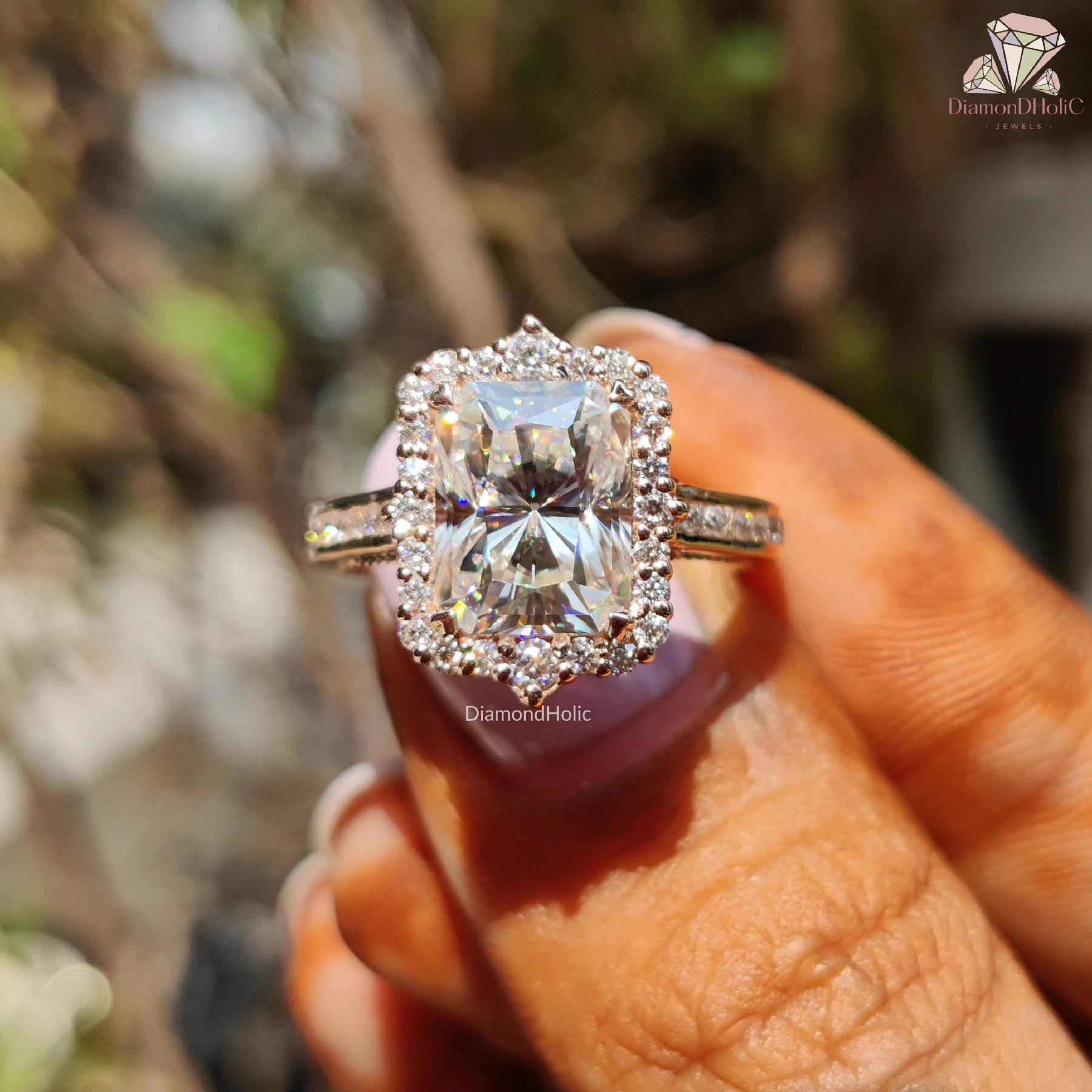
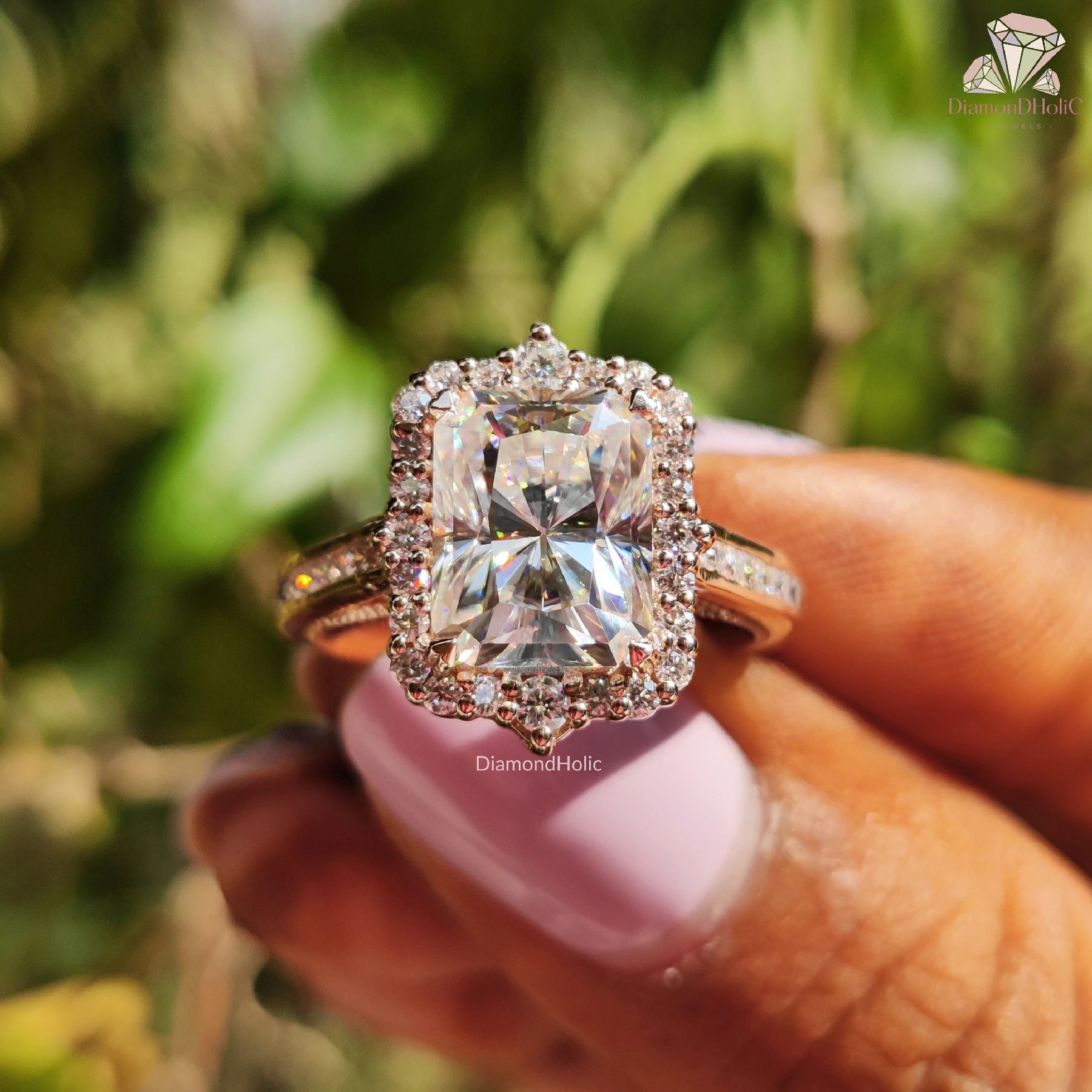
Larger moissanite stones amplify the rainbow fire effect, which some buyers love and others find distracting. Step cuts like emerald or Asscher shapes show less splintery sparkle, which can appeal to buyers who want something subtler. If you are curious about how different cuts show moissanite’s fire, a radiant cut hidden halo ring is a good example of how cut shapes the sparkle.
Durability: Which Stone Lasts Longer?
Both stones handle daily engagement ring wear well, but they are not equal.
Diamond sits at 10 on the Mohs hardness scale, making it the hardest known natural material. Moissanite scores about 9.25, which GIA confirms in its assessment of synthetic moissanite’s properties. That makes moissanite harder than sapphire (9) and significantly harder than most other gemstones.
In practical terms, moissanite resists scratching in everyday life. You can wash dishes, type, garden, and go about your day without worrying about surface damage. Diamond is more scratch-resistant, but the difference rarely matters in normal wear.
What does matter: the setting. A tough stone can still be lost if prongs loosen or bend. Regular inspections of prongs, pavé stones, and band integrity protect your ring more than any hardness rating. This applies equally to moissanite and diamond.
Moissanite works well in wedding bands and eternity rings too, not just center stones. Its hardness handles the bumps that daily-wear bands take.
Price: Why Moissanite Costs Less
Moissanite is not cheaper because it is inferior. It is cheaper because it is a different material with a different supply chain and market structure.
Blue Nile’s pricing shows the gap clearly: a 1-carat diamond typically runs $3,000 to $5,000, while an equivalent-size moissanite costs roughly $500 to $600. That is not a small difference. It is the difference between a ring and a ring plus a honeymoon fund.
Diamond pricing depends on the 4Cs (cut, color, clarity, carat weight), origin, and certification. Each variable shifts the price. A D-color, internally flawless natural diamond commands a premium that has no parallel in the moissanite market. Moissanite pricing is simpler: size, shape, color range, and the seller’s brand positioning.
This price gap is why moissanite appeals to buyers who want a larger stone or a more elaborate setting without stretching the budget. A three-stone radiant moissanite ring that would cost thousands with diamonds becomes accessible at a fraction of the price.
One important note: do not expect resale value from either moissanite or lab-grown diamonds in the way some people expect from natural diamonds. All engagement ring stones lose value the moment they leave the retailer.
Moissanite vs Lab-Grown Diamond
This is where many shoppers get stuck. If moissanite is not a diamond and lab-grown diamond is a real diamond, how do you choose between them?
Lab-grown diamonds are chemically, physically, and optically identical to natural diamonds. GIA confirms they can only be reliably separated from natural diamonds by professional labs or advanced testing devices. They come with standard diamond grading (4Cs), often at 30-70% less than natural diamonds of comparable quality.
Moissanite is a different stone altogether. It costs less than lab-grown diamond, throws more rainbow fire, and does not carry diamond grading.
| Your priority | Better fit |
|---|---|
| Lowest price for a large center stone | Moissanite |
| Real diamond material and grading | Lab-grown diamond |
| Strong rainbow fire | Moissanite |
| Classic diamond sparkle | Lab-grown diamond |
| Maximum budget flexibility | Moissanite |
| Diamond identity without mined origin | Lab-grown diamond |
If the word “diamond” matters to you emotionally or symbolically, lab-grown diamond is the right path. If you genuinely prefer moissanite’s look and want to stretch your budget further, moissanite stands on its own merits.
Compare an IGI-certified lab-grown diamond ring to see how lab diamonds are graded and documented.
Can You Tell Moissanite From Diamond?
Most casual observers cannot tell the difference on someone’s hand. Your coworkers, your friends at dinner, the stranger in the elevator, they are not going to spot it.
Trained jewelers and gemologists can. Under magnification, moissanite’s doubled facet junctions are a clear giveaway. In motion under bright light, the stronger rainbow fire is noticeable to someone who knows what to look for.
Here is a detail that surprises many buyers: standard thermal diamond testers can misidentify moissanite as diamond. GIA notes that moissanite’s thermal properties are close enough to diamond that thermal probes may react as if testing a real diamond. This means a basic “diamond tester” pen from Amazon is not reliable for distinguishing the two. Electrical conductivity testers or professional gemological examination are more accurate.
Reddit users who own both stones consistently say that side-by-side comparisons, direct sunlight, and jewelry-store spotlights make the differences more obvious. On its own, especially in moderate sizes, a well-cut moissanite is hard to distinguish without training.
Who Should Choose Moissanite?
Choose moissanite if:
- You love rainbow fire and want a stone that throws color in every direction
- You want a larger stone for a lower budget
- You do not need the stone to be a diamond
- You want a durable gemstone rated 9.25 on the Mohs scale
- You are comfortable saying “it’s moissanite” rather than pretending it is a diamond
Moissanite does not have to imitate diamond to be beautiful. Colored options like a green moissanite ring prove that the stone has its own design identity beyond looking like a diamond substitute.
On WeddingWire forums, moissanite supporters consistently cite affordability, ethics, larger stone size, and not wanting to overspend as their reasons. Several users mentioned redirecting the savings toward a house down payment or honeymoon.
Who Should Choose Diamond?
Choose a diamond (natural or lab-grown) if:
- You specifically want the word “diamond” to be accurate
- You prefer restrained white sparkle over rainbow fire
- You want standardized 4Cs grading from a recognized lab
- You worry you will regret not getting a diamond
- You want a more traditional engagement ring story
The regret factor deserves extra attention. In a candid thread on r/EngagementRings, some buyers shared that they switched from moissanite to lab-grown diamond because they preferred diamond’s depth and subtler shimmer. One user advised plainly: if you want a diamond, get a diamond rather than forcing yourself to like moissanite.
That advice cuts both ways. Regret almost always comes from expectation mismatch, not from a defect in the stone. People who choose moissanite because they genuinely like it tend to stay happy. People who choose moissanite as a reluctant compromise for the diamond they actually wanted tend to second-guess themselves.
Explore round lab-grown diamond rings if diamond identity is what you are after.
What Paperwork Should You Ask For?
Certification and documentation differ between moissanite and diamond, and this is a source of real confusion. A jewelry industry practitioner on LinkedIn pointed out that buyers frequently ask whether moissanite comes with a “GIA certificate,” not realizing that moissanite does not use diamond-style grading.
For lab-grown diamond
Ask for a grading report from a recognized lab (IGI, GIA, or equivalent). The report should include the 4Cs, measurements, fluorescence, and growth method (HPHT or CVD). Confirm the report number so you can verify it independently. DiamondHolic Jewels includes IGI certification with lab-grown diamond purchases.
For moissanite
Ask for documentation that identifies the stone, its size in millimeters, color range, and cut style. Moissanite does not have a universally standardized grading system like the 4Cs. A card or certificate should tell you what the stone is and its specifications, not present it as a diamond grading report.
For any ring
Get the metal type and purity, ring size, center stone dimensions, side stone details, and the return or exchange policy in writing. The FTC advises consumers to get origin, weight, treatments, and care details documented before purchase.
Understanding “carat equivalent”
Moissanite is typically sold by millimeter size, not carat weight. A moissanite that measures 6.5mm across (the same face-up size as a 1-carat round diamond) actually weighs about 15% less than that diamond. Sellers often list a “diamond equivalent weight” (DEW) to help you visualize size, but the stone’s actual carat weight is lower. Always check whether the listed “carat” refers to actual weight or diamond-equivalent size.
When Moissanite Is the Wrong Choice
Being honest about this builds trust. Moissanite is not for everyone.
It is the wrong choice if you are buying it only because you cannot afford a diamond and plan to pretend it is one. That path leads to anxiety about being “found out,” which defeats the purpose of an engagement ring.
It is the wrong choice if you strongly prefer the way diamonds look. Moissanite’s rainbow fire is beautiful, but it is visually distinct. If you find yourself wishing the moissanite sparkled less or looked “calmer,” you probably want a diamond.
It is the wrong choice if standardized grading and certification from labs like GIA or IGI matters to you in the way it matters for diamonds. Moissanite does not have that infrastructure.
None of these make moissanite a bad stone. They just mean it is the wrong stone for that particular buyer.
Buying Checklist
If you are buying moissanite
- Confirm stone size in millimeters, not just “carat equivalent”
- Ask about the color range (colorless, near-colorless, warm, or colored)
- Request video of the stone in daylight and indoor lighting
- Ask what documentation comes with the stone
- Confirm whether side stones are moissanite, diamond, or another material
- Review the return and exchange policy before ordering
- For custom designs, ask about CAD previews before production
If you are buying lab-grown diamond
- Ask for the grading report and verify the lab name and report number
- Review cut, color, clarity, carat, measurements, and fluorescence
- Confirm whether the stone is HPHT or CVD grown
- Get metal and setting details in writing
- Confirm whether IGI or GIA certification is included
If you are comparing both
- Judge stones in motion, not from still photos alone
- Compare the same shape in both materials when possible
- Consider your metal choice (warm gold can soften moissanite’s icy tones)
- Ask yourself honestly: do I want moissanite, or do I want a diamond I cannot afford?
Frequently Asked Questions
Is moissanite better than diamond?
It depends on what “better” means to you. Moissanite is better for price, size per dollar, and rainbow fire. Diamond is better for classic white sparkle, standardized grading, tradition, and the simple fact of being diamond. Neither stone is universally superior.
Is moissanite a real diamond?
No. Moissanite is real moissanite (silicon carbide), not a real diamond (carbon). It is a genuine gemstone in its own right, just not a diamond. Lab-grown diamond is a real diamond. These are three separate categories.
Can a jeweler tell moissanite from diamond?
Yes. A trained gemologist can identify moissanite through magnification (looking for doubled facet junctions) and proper testing equipment. Standard thermal diamond testers may give false “diamond” readings because moissanite’s thermal conductivity is close to diamond’s. Electrical conductivity testers are more reliable.
Does moissanite get cloudy over time?
Moissanite itself does not become internally cloudy. What people sometimes describe as cloudiness is surface buildup from lotions, soap, oils, and daily grime. Regular cleaning restores the sparkle. This is a maintenance issue, not a material defect.
Why does moissanite sparkle more than diamond?
Moissanite’s dispersion (0.104) is more than double diamond’s (0.044), according to GIA’s published data. Higher dispersion means more spectral color separation, which produces those strong rainbow flashes. Whether “more sparkle” is a good thing depends entirely on personal taste.
Is lab-grown diamond the same as moissanite?
No. Lab-grown diamond is carbon with the same chemical, physical, and optical properties as natural diamond. Moissanite is silicon carbide. They are different materials that happen to share some visual similarities. Confusing the two is one of the most common mistakes in ring shopping.
Which looks more expensive, moissanite or diamond?
In moderate sizes with quality cuts, moissanite can easily pass as a high-end stone to casual observers. Very large moissanite stones (above 2 carats equivalent) tend to show noticeably more rainbow fire, which can look different from what people expect of a diamond. The setting, metal, and overall ring design influence perceived value as much as the center stone.
Should I feel bad about choosing moissanite?
No. The stone on your finger should make you happy, full stop. If moissanite’s look, durability, and price align with what you want, it is a perfectly valid choice. If you are choosing it reluctantly as a stand-in for a diamond you actually want, that is worth reconsidering, not because moissanite is inferior, but because you deserve a ring you are genuinely excited about.
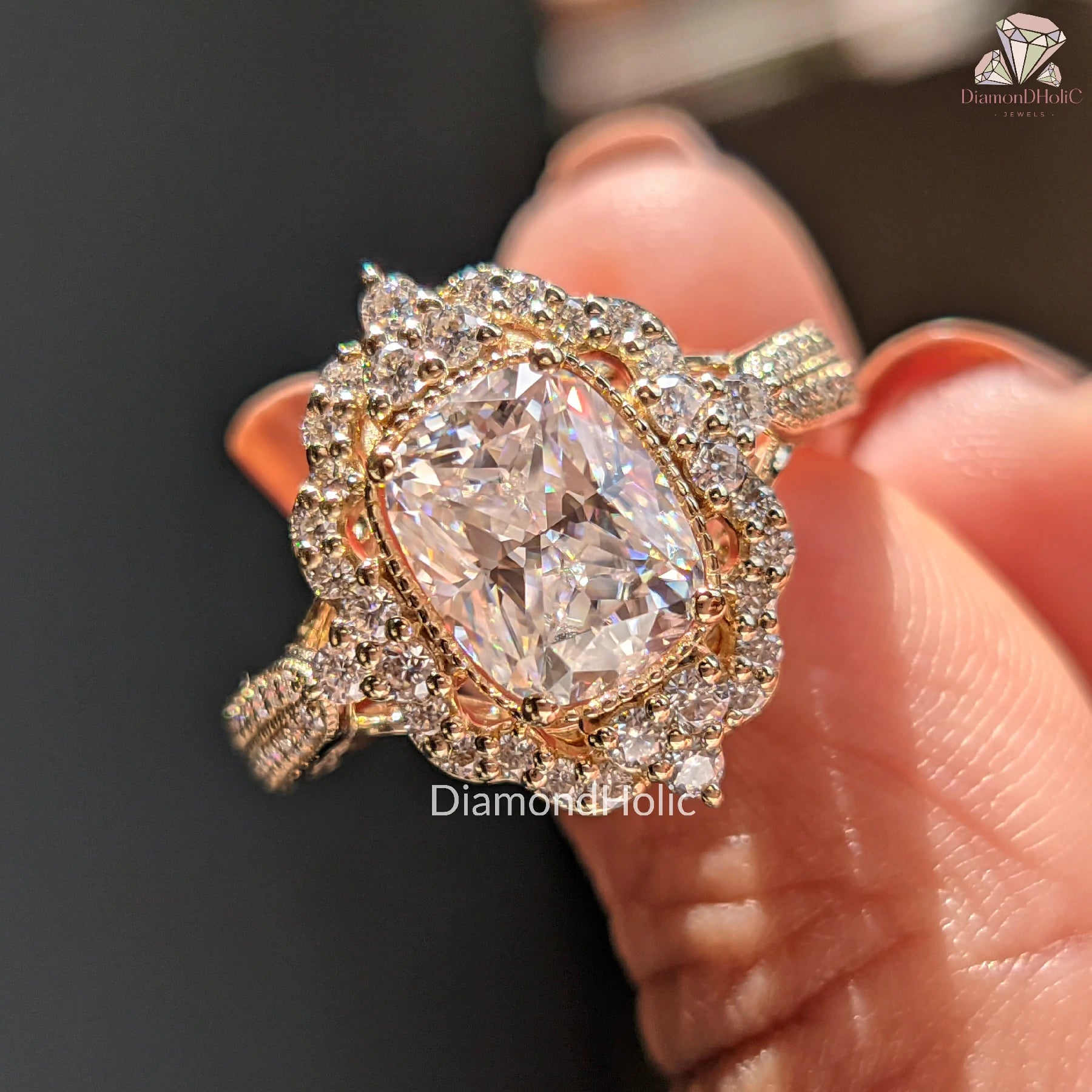
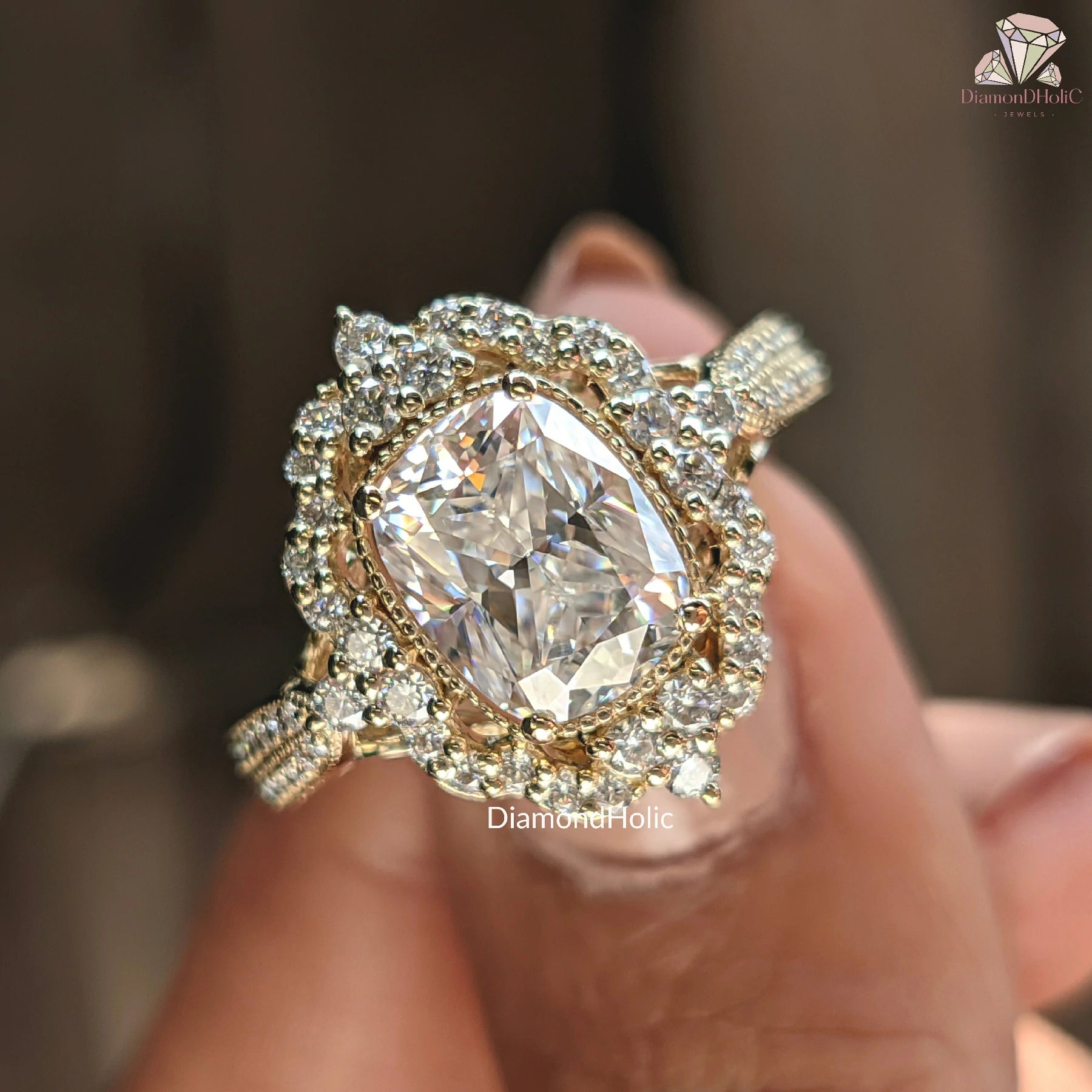
Browse moissanite bridal ring sets or explore lab-grown diamond designs to compare both options side by side.


From $350.00 - $1,223.00
From $190.00 - $1,135.00
From $307.00 - $763.00


From $327.00 - $945.00


From $357.00 - $1,099.00


From $315.00 - $1,058.00


From $237.00 - $867.00


$799.00
$1,150.00


$799.00
$1,150.00


$799.00
$1,150.00
$949.00
$1,250.00


$330.00
$1,687.50


$480.00
$2,558.75


$2,197.44
$2,746.80


$317.23
$396.54
$2,197.44
$2,746.80


$317.23
$396.54


$282.83
$353.54
0 comments