



Trusted by 1,300+ couples across the US
↓ Start Reading
Before You Buy Any Moissanite Ring — Read This First
If you've been researching engagement rings online,
you've probably run into three problems:
→ Too many options with no clear way to compare them
→ Salespeople who push expensive stones without explaining why
→ No honest breakdown of what actually matters for daily wear
This guide fixes all three.
In the next 5 minutes you'll know exactly:
what to look for, what to avoid, how to size correctly,
and how to care for a Moissanite ring for life.
No sales pitch. Just the information most jewelers
keep to themselves.
What This Handbook Covers
💎 WHAT IS MOISSANITE?
The science, the origin, and why it outperforms
most gemstones on brilliance and durability.
📐 THE 4 Cs FOR MOISSANITE
Cut, Color, Clarity, and Carat — what they mean
for Moissanite specifically (different from diamonds).
⚖️ MOISSANITE vs. LAB GROWN vs. DIAMOND
An honest side-by-side comparison so you can
make the right choice for your lifestyle and budget.
📏 HOW TO SIZE YOUR RING FROM HOME
Step-by-step ring sizing without visiting a store
accurate to within half a size.
✨ DAILY CARE & CLEANING
How to keep your Moissanite ring looking
brand new for decades.
🛡️ LIFETIME TIPS
Storage, travel, exercise, water, chemicals —
what to do and what to avoid.
Chapter 1
What Is Moissanite?
Moissanite was first discovered in 1893 by French scientist
Henri Moissan inside a meteor crater in Arizona.
The original stone was silicon carbide — one of the hardest,
most brilliant minerals ever found on Earth.
Natural Moissanite is extraordinarily rare.
What you find in jewelry today is lab-created Moissanite —
grown under controlled conditions that replicate
the original stone's chemical structure perfectly.
The result:
→ A gemstone rated 9.25 on the Mohs hardness scale
(diamond is 10 — sapphire is 9)
→ Higher refractive index than diamond — meaning more fire,
more brilliance, more visible sparkle in every light
→ Conflict-free by nature — lab-created, not mined
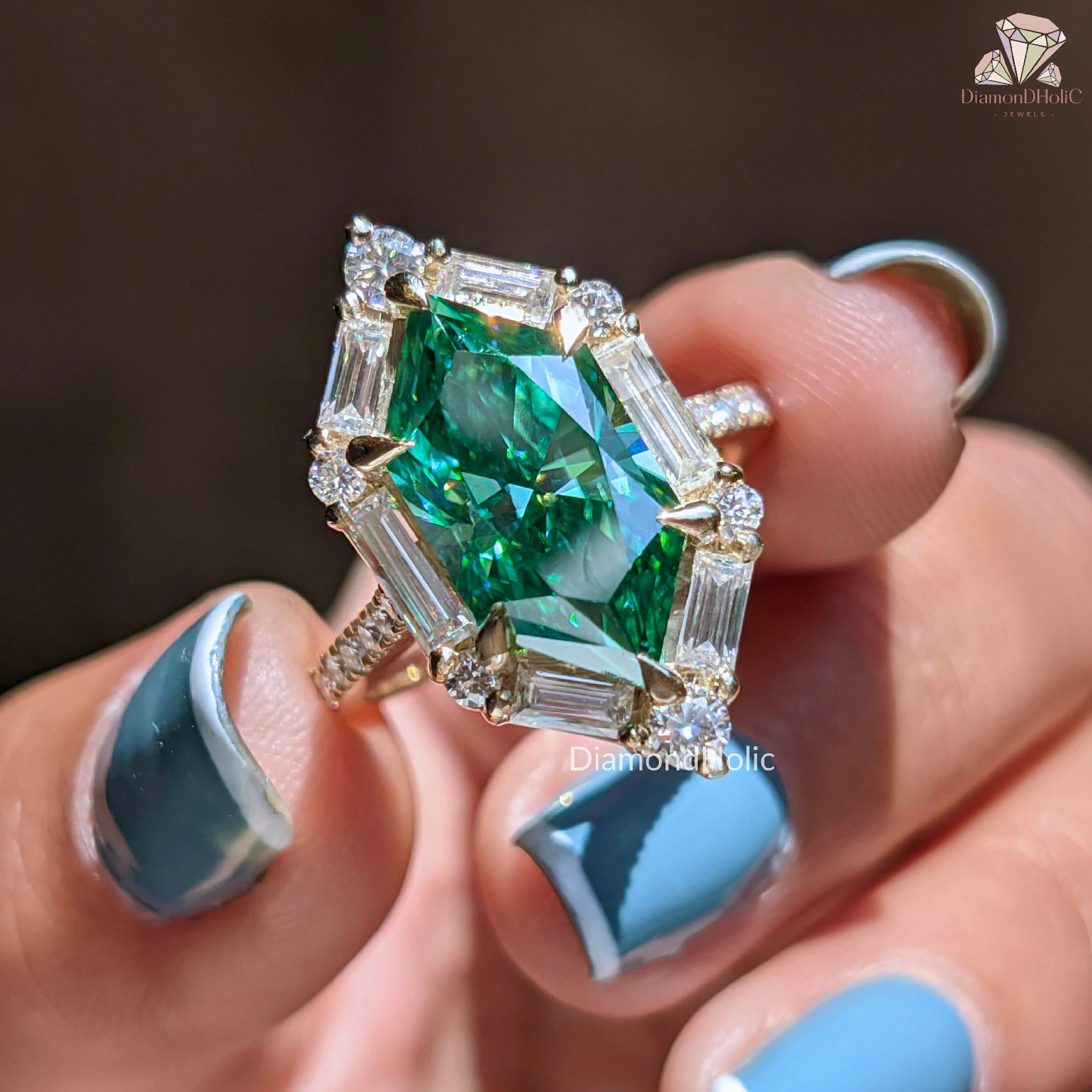
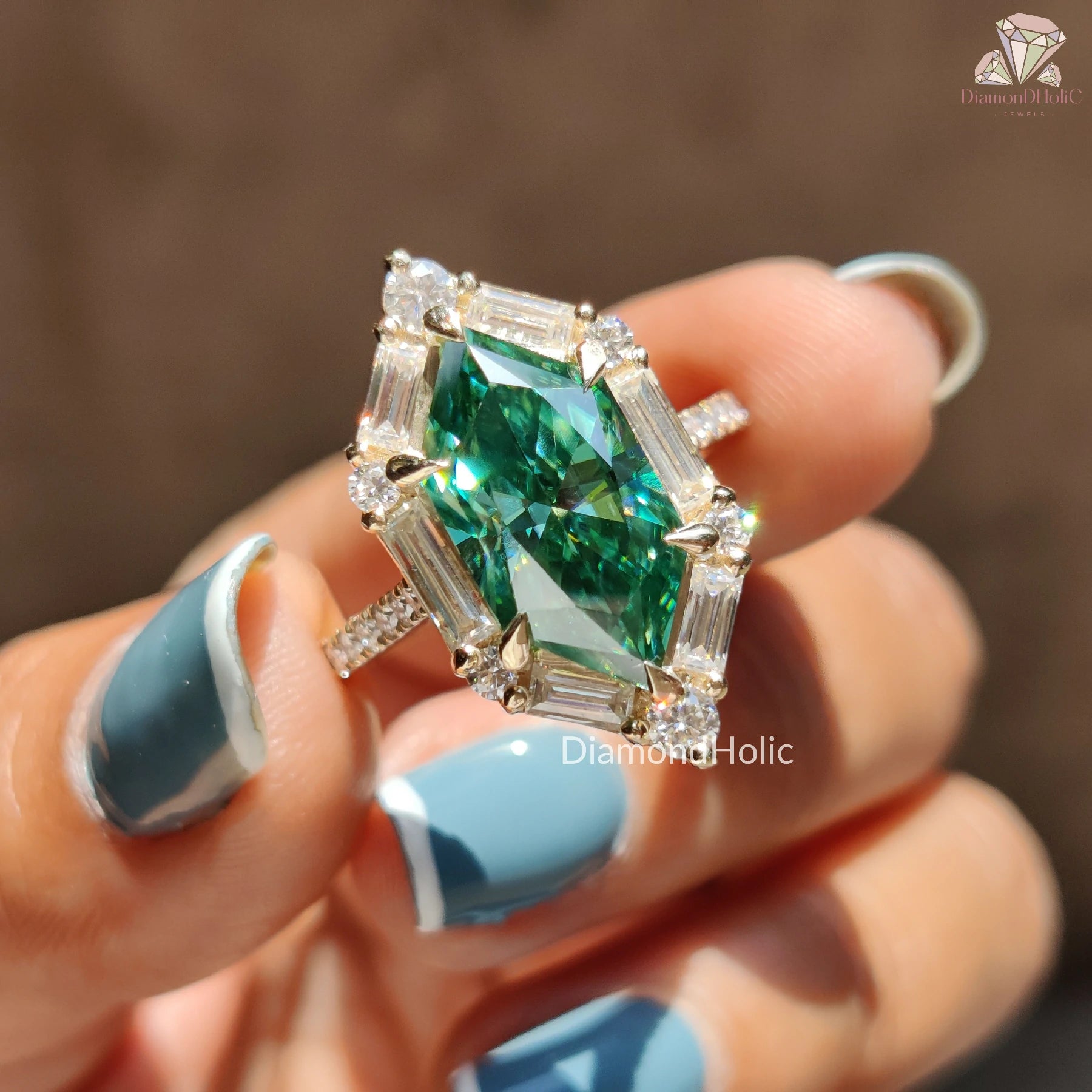
→ Available in white, grey, yellow, green, blue, and more
Moissanite isn't a diamond substitute.
It's a premium gemstone in its own category —
one that happens to outperform diamond on brilliance
and cost a fraction of the price.

Chapter 2
The 4 Cs — What They Mean for Moissanite
You've heard of the 4 Cs for diamonds.
Moissanite has the same framework — but the details are different.
Here's what actually matters.

CUT
The most important of the 4 Cs for Moissanite.
Cut determines how light travels through the stone —
and Moissanite's high refractive index means
a well-cut stone produces dramatically more fire
than a poorly cut one.
What to look for:
→ Radiant Cut — 70 facets — maximum brilliance for colored stones
→ Round Brilliant — classic, highest light return
→ Oval — elongates the finger, looks larger than carat weight
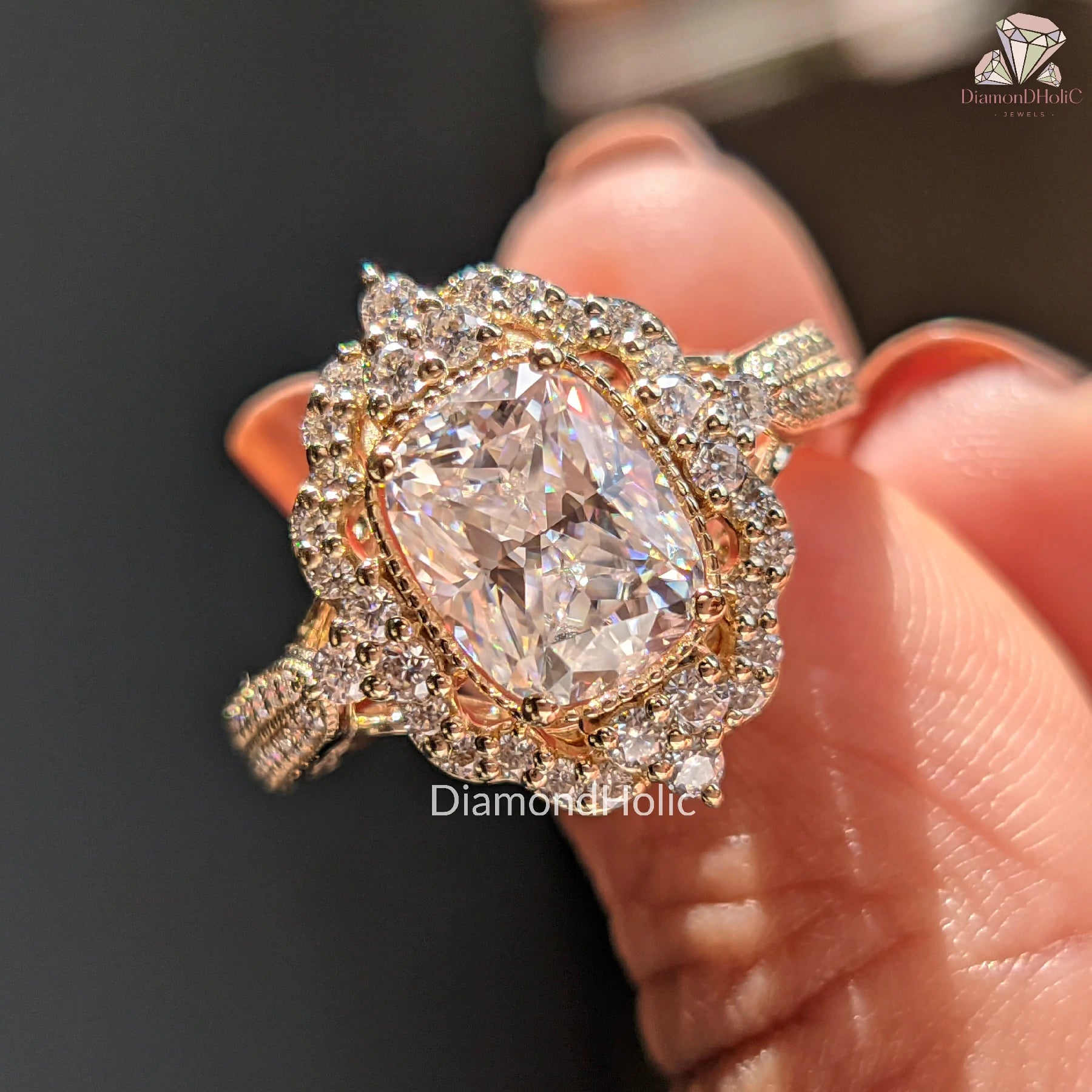
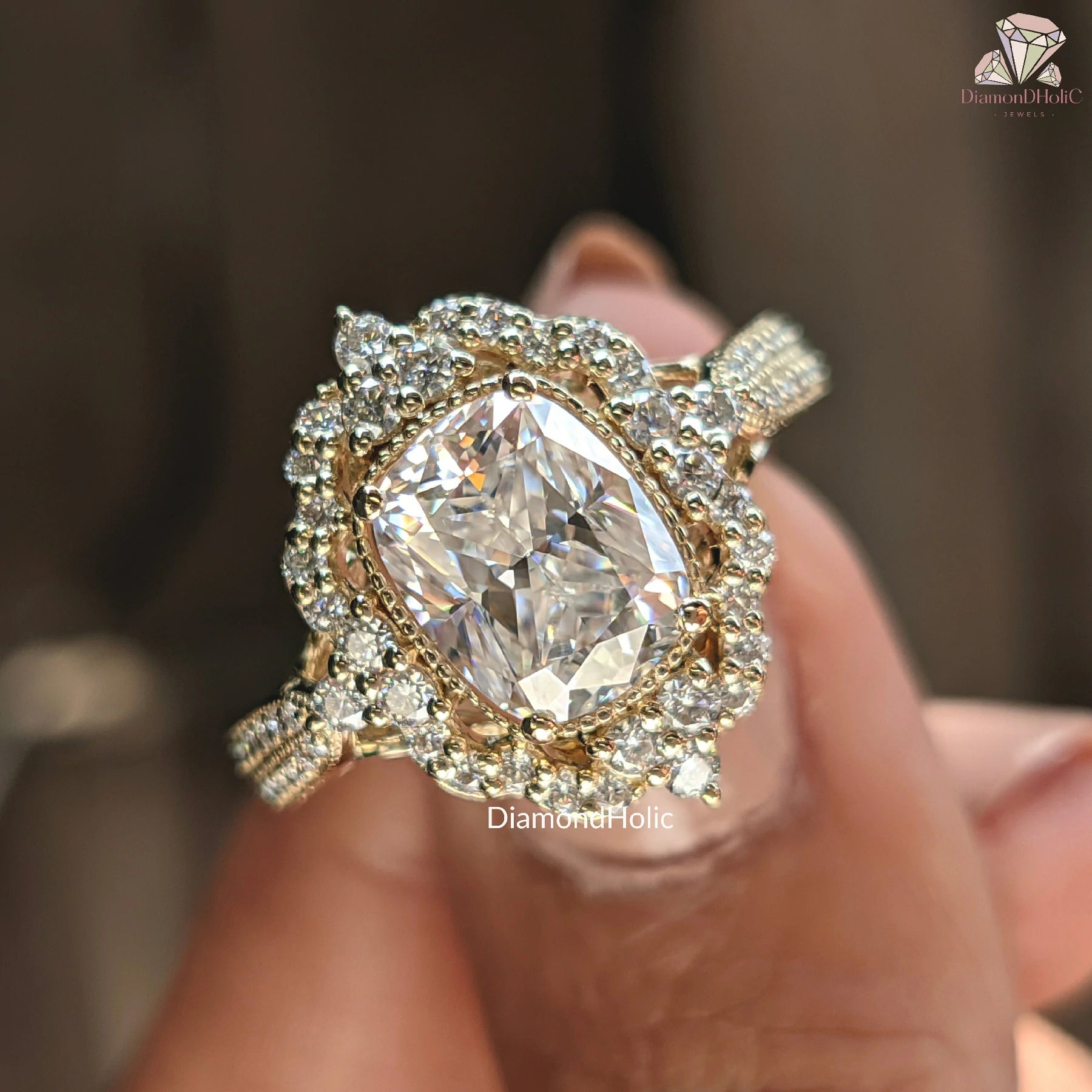
→ Cushion — soft romantic glow, vintage aesthetic
→ Emerald — architectural, step-cut, shows clarity not brilliance
What to avoid:
→ Deep cuts that trap light at the bottom
→ Asymmetrical facets — visible with naked eye under direct light

COLOR
Moissanite color is graded differently from diamonds.
Standard grades:
→ Colorless (equivalent to D-E-F diamond range)
→ Near-colorless (equivalent to G-H-I-J range)
→ Faint color (K and below equivalent)
For fancy colored Moissanite (green, blue, yellow):
Color is the point — it's intentional and permanent.
Lab-created colored Moissanite holds its color
for life — it's not a coating or treatment that fades.
This is what separates it from color-treated stones
that lose vibrancy over years of daily wear.

CLARITY
Moissanite is lab-created — which means inclusions
are far less common than in natural gemstones.
Most Moissanite stones are eye-clean —
meaning no visible inclusions to the naked eye.
For engagement rings, eye-clean is the standard
you should expect. Anything requiring magnification
to appear clean is not worth the premium.
What DiamondHolic Jewels inspects:
→ Surface finish under direct light
→ Internal clarity under loupe inspection
→ Facet alignment and symmetry
→ Color consistency across the stone

CARAT
Moissanite is lighter than diamond by approximately 15%.
This means a 1.00ct Moissanite is slightly larger
in diameter than a 1.00ct diamond of equal weight.
When shopping for Moissanite, always ask for
the millimeter diameter — not just the carat weight.
The visual size of the stone on the hand is determined
by diameter, not weight.
Example:
1.00ct Round Diamond = ~6.5mm diameter
1.00ct Round Moissanite = ~6.5mm diameter
(similar visual size, lighter weight)
2.00ct Moissanite = ~8.1mm diameter
= looks equivalent to a 2.00ct diamond
= costs a fraction of the diamond price
Chapter 3
Moissanite vs. Lab Grown vs. Diamond
The Honest Side-by-Side
| MOISSANITE | LAB DIAMOND | NATURAL DIAMOND | |
|---|---|---|---|
| Hardness (Mohs) | 9.25 | 10 | 10 |
| Brilliance | Highest | High | High |
| Color Options | Wide | Limited | Limited |
| Conflict-free | Yes | Yes | Varies |
| Price per Carat | $ | $$ | $$$$ |
| Fading Risk | None | None | None |
| Daily Wear Safe | Yes | Yes | Yes |
| Certification | GRA | IGI | GIA |
The honest answer:
There is no universally "best" gemstone.
There is only the best gemstone for your lifestyle,
your budget, and what matters to you.
If certification as a diamond is non-negotiable — choose lab-grown diamond.
If maximum brilliance, color options, and value matter — choose Moissanite.
If you want the hardest stone regardless of cost — choose natural diamond.
If you want a specific natural color — choose a natural colored gemstone,
but understand the durability tradeoff.
DiamondHolic Jewels offers all of the above.
This guide doesn't exist to push you toward one choice.
It exists to make sure you make the right choice for you.
Chapter 5
How to Keep Your Moissanite Ring Looking Brand New
Moissanite is one of the most durable gemstones you can wear.
But a few simple habits will keep it looking flawless for decades.
Weekly Cleaning:
What you need:
→ Warm water
→ A few drops of mild dish soap
→ A soft toothbrush (new, unused)
→ A lint-free cloth
Step 1: Mix warm water with a small drop of mild dish soap.
Step 2: Soak the ring for 20–30 minutes.
Step 3: Gently scrub under and around the stone with the soft brush.
Step 4: Rinse under warm running water.
Step 5: Pat dry with a lint-free cloth.
Step 6: Leave to air dry completely before storing or wearing.
How often: Once a week for daily-wear rings.
What's Safe:
✅ Water — swimming, showering, washing hands
✅ Mild soap
✅ Ultrasonic cleaners (for Moissanite — confirm metal compatibility)
✅ Steam cleaning (professional jewelry cleaner)
✅ Gym and exercise — Moissanite won't chip from impact at the gym
What to Avoid:
❌ Chlorine bleach — can damage metal settings over time
❌ Harsh chemical cleaners — acetone, ammonia-based products
❌ Abrasive cloths or paper towels — will scratch the metal, not stone
❌ Storing with other jewelry without a pouch — stones can scratch metal
❌ Applying lotions, perfumes, or hairspray while wearing the ring
(apply products first, put ring on after)
Chapter 6
Lifetime Tips for Your Moissanite Ring
TIP 1 — STORAGE
Store your ring in a soft pouch or a lined jewelry box.
Never drop it loose into a drawer with other jewelry.
Metal scratches metal. Stone can scratch soft metals.
A separate pouch costs nothing and prevents years of wear.
TIP 2 — TRAVEL
When traveling, keep your ring in its pouch
inside your carry-on — never in checked luggage.
If going to a beach or pool, leave the ring in the hotel safe.
Sand is abrasive and ocean water contains salts that
can dull metal settings over time.
TIP 3 — EXERCISE
Moissanite rated 9.25 Mohs — safe for gym wear.
The risk isn't the stone — it's the metal setting.
Weightlifting can bend prongs over time.
If you lift heavy regularly — consider a bezel or channel setting
for maximum prong protection.
TIP 4 — PROFESSIONAL CHECK
Visit a jeweler once every 12–18 months for:
→ Prong inspection (check for loosening)
→ Professional ultrasonic clean
→ Setting tightness check
This takes 10 minutes and keeps your ring secure for decades.
TIP 5 — CHEMICAL EXPOSURE
Cleaning products, swimming pool chlorine, and beauty products
can dull metal settings over years of exposure.
Remove your ring before using cleaning products.
Put it back on after your beauty routine is complete.
TIP 6 — RESIZING
If your ring ever needs resizing —
Moissanite rings can be resized by most skilled jewelers.
Always go to a jeweler experienced with Moissanite settings
specifically — not a general high street jeweler.
Ask before they touch it: "Have you resized Moissanite rings before?"
About DiamondHolic Jewels
DiamondHolic Jewels is a luxury jewelry brand specializing
in Moissanite and Lab-Grown Diamond jewelry — crafted to order,
inspected to standard, and approved by you before it ships.
Every ring is made through a process most jewelry brands skip:
→ A full CAD design is created for your order
→ You see the exact ring before a single stone is set
→ You approve the design before production begins
→ Quality inspection by specialists — twice
→ Photos and video sent to you before shipping
→ Your final approval before it ever leaves our hands
No ring ships before you say yes.
That's not standard in the jewelry industry.
But it's standard here.
Accepted payment methods:
Apple Pay · Google Pay · Visa · Mastercard
American Express · Debit Cards · Easy EMI Financing
Questions We Get Asked Before Every Order (faq)
Is Moissanite a real gemstone?
Yes. Moissanite is a genuine gemstone — silicon carbide — first discovered in a meteor crater in 1893. Lab-created Moissanite has the same chemical structure as the original natural stone. It is not a diamond, and it is not an imitation. It is its own premium gemstone.
Will Moissanite lose its sparkle over time?
No. Unlike cubic zirconia, which clouds over time, Moissanite retains its brilliance permanently. Its refractive index does not change with age. A well-maintained Moissanite ring looks the same in 30 years as it does on day one.
Can people tell it's not a diamond?
Most cannot. Moissanite has more fire and brilliance than diamond — which sometimes gives it away to gemologists under magnification. To the naked eye in everyday settings, the vast majority of people cannot distinguish it from diamond.
How long does a custom order take?
Custom jewelry at DiamondHolic Jewels follows a full production process — CAD design, your approval, production, two quality inspections, photos sent to you, and your final approval before shipping. This process ensures quality. It takes time. Contact us directly for current production timelines.
What if the ring doesn't fit?
We send you sizing guidance before production begins. If a sizing issue occurs after delivery, contact our customer service team directly for assistance.
Is Moissanite good for daily wear?
Yes. At 9.25 Mohs hardness — harder than sapphire and ruby — Moissanite is one of the most durable gemstones available for daily wear. It resists scratching, chipping, and cloudiness better than most alternatives.
Do you offer lab-grown diamonds as well?
Yes. DiamondHolic Jewels offers both Moissanite and Lab-Grown Diamond jewelry. If you want GIA or IGI certified diamond — we have that option. Contact us to discuss which is right for you.
What payment methods do you accept?
Apple Pay, Google Pay, Visa, Mastercard, American Express, Debit Cards, Credit Cards, and Easy EMI Financing for eligible customers.
Ready to Find Your Ring?
Browse the full Moissanite collection at DiamondHolic Jewels.
Every ring is custom made, CAD approved, and customer approved
before it ever ships.


From $269.00 - $949.00


From $350.00 - $1,223.00


From $229.00 - $748.00


From $215.00 - $833.00
From $330.00 - $1,140.00
From $190.00 - $1,135.00


From $254.00 - $921.00